🔧 Deck Repair in St. Joseph, MO
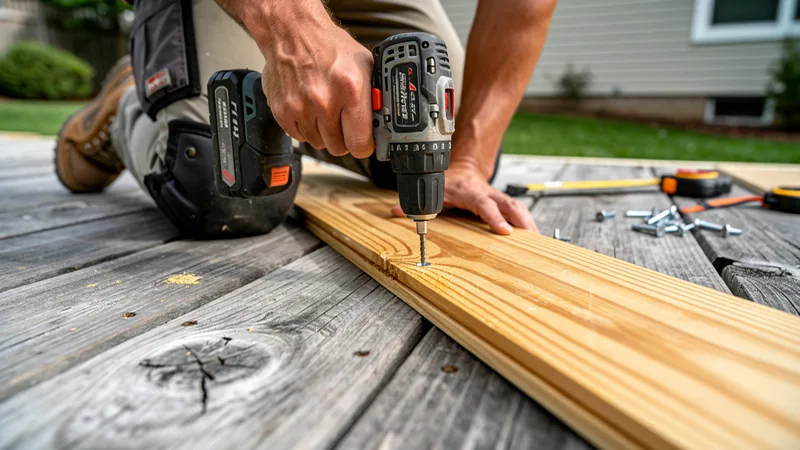
St. Joseph Deck Builders provides deck repair in St. Joseph, MO.
Free On-Site Estimates · Permit Handling Included · Wood & Composite Decking
Board replacement, structural repairs, and fixing decks that were never built to the local 36-inch frost depth.
A lot of the deck repairs we get called for around St. Joseph and Buchanan County trace back to a footing that was never poured to the full 36-inch local frost line, not just normal wear. This shows up most often on older homes in and around the Museum Hill and Hall Street areas, built long before current permit enforcement was consistent. We inspect the substructure before recommending a fix, so a deck that needs new footings gets new footings, not just fresh boards over a shifting frame.
📞 Call (816) 596-2985Frequently Asked Questions
Do I need a permit to build a deck in St. Joseph, MO?
Decks and porches require a City of St. Joseph building permit, which we pull and handle as part of the job, including the occupational license and insurance documentation the city requires from the contractor. Small, low decks may qualify for an exemption — we confirm this during your on-site estimate.
How deep do deck footings need to be in St. Joseph?
St. Joseph's building code sets the local frost line at a full 36 inches, and footings need to clear that depth to avoid heaving during winter freeze-thaw cycles. A footing designed for a shallower frost zone elsewhere in Missouri is not code-compliant here.
How much does a new deck cost in St. Joseph, MO?
Pressure-treated wood decks typically run $25 to $45 per square foot installed, while composite decking runs $45 to $85 per square foot, depending on size, height above grade, and structural complexity. We confirm final pricing with a written quote after the on-site estimate.
How often should a wood deck be restained in this climate?
Most wood decks in the St. Joseph area need restaining every 2 to 3 years given the river-valley humidity, sooner for decks with heavy afternoon sun exposure on an open bluff lot. Composite decking never needs restaining.
What areas do you serve around St. Joseph?
St. Joseph, Savannah, Easton, De Kalb, Faucett, and the rest of Buchanan and Andrew counties, MO.
My home is near Museum Hill or Hall Street — does that affect my deck project?
Homes within or near St. Joseph's historic districts sometimes have additional design review requirements for exterior changes visible from the street. We check whether your property falls under any such review during the free on-site estimate, before finalizing a design.
My lot is sloped — can you still build a deck?
Yes — a meaningful share of St. Joseph properties sit on the bluffs above the Missouri River and have real grade change in the backyard. We design multi-level decks with landings and stair transitions specifically for that terrain rather than treating every lot as flat.
How long can deck stairs run without a landing?
Under the residential code a single flight of stairs can't rise more than 151 inches, about 12 feet 7 inches, between floors or landings. On St. Joseph's bluff and hillside lots, where a deck can sit well above the yard, that often means a landing partway down. A landing is also the easiest way to turn the stair so it fits a sloped yard, and it gives a place to stop on a long climb.
How long does a wood deck last before it needs replacing?
A pressure-treated wood deck that's cleaned and resealed regularly usually lasts 15 to 20 years in this climate; one that's been neglected can need major work in 10. The boards and railings wear out first and can be replaced on their own; the real end of a deck's life is rot in the posts, beams, joists or the ledger against the house. If the frame is sound, re-decking costs much less than starting over.
Why is my deck stain peeling?
Peeling almost always comes from a film-forming stain or paint that was put on too thick, over an old coat that wasn't stripped, or on wood that was still damp. Water gets under the film, the sun bakes it, and it lifts in sheets, especially on horizontal boards. The fix is to strip or sand back to bare wood, let it dry, and switch to a penetrating stain that soaks in rather than sitting on top.
Can you build a deck over an existing concrete patio?
Often, yes. If the slab is solid, reasonably level and slopes away from the house, a low deck can be framed on sleepers over it, with spacers so water drains underneath. A cracked, heaving slab or one that slopes toward the house is the wrong base; in that case the deck gets its own footings beside or through the old patio.
Should deck boards be spaced apart?
Yes. Gaps let water drain and air dry the boards from underneath. Pressure-treated wood often arrives wet and shrinks as it dries, so it's frequently installed tight or with a small gap and opens up on its own; kiln-dried wood and composite get a set gap, typically 1/8 to 1/4 inch, and composite manufacturers also specify end-to-end gaps for temperature changes. Leaves packed into the gaps are worth clearing, since they hold moisture.
Can rotted deck joists be repaired instead of rebuilding the deck?
Usually, when the rot is limited. A soft joist end or a section near the ledger can be reinforced by sistering a new joist alongside it, and a single rotted post or beam can be replaced with the deck shored up. If rot runs through many joists, the ledger and the posts, a rebuild on new footings is safer. Probing the framing with a screwdriver is the quick test: wood that gives easily needs attention.